



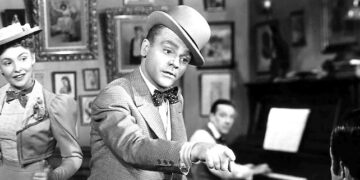



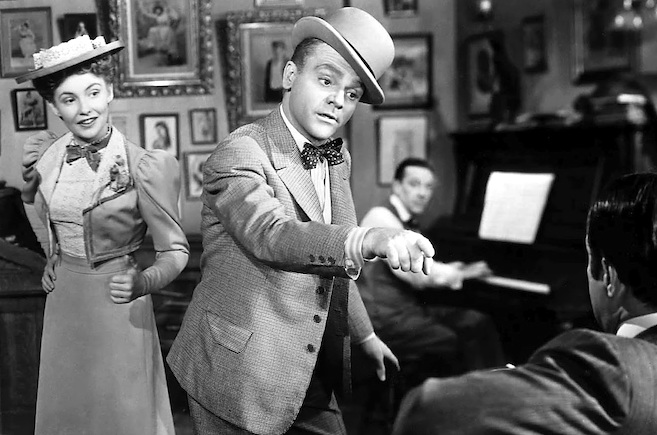
Yankee Doodle Dandy (1942) stars James Cagney in this musical biopic of the legendary Broadway song and dance man, performer, playwright, songwriter – and, supposedly born on the 4th of July – George M. Cohan (1878-1942). A proud American of Irish decent who was a great patriot. Cohan wrote many songs. You’ll be surprised by how many you may recognize, even though they were all written over 100 years ago!
It doesn’t matter that previously Cagney had met Cohan, only once and briefly, at an audition when Cagney was a struggling song and dance man himself. He didn’t get the job. And one can only speculate if it was because Cohan had recognized himself in Cagney’s talent, drive and physical appearance. He may have decided not to have this younger version of himself competing right next to him, up on stage. But, Cohan was smart enough to give his approval to having Cagney play him, decades later, in his own biopic.
It doesn’t matter that one of the reasons Cagney wanted to play the patriotic Cohan was because of his off-screen support of unions. Cagney’s support was so intense that it was making him unpopular at his home studio of Warner Brothers. It was Cagney’s pragmatic brother/manager, William Cagney, who actively pursued the role of the ultra-patriotic George M. Cohan for his brother, Jim. He saw it as a way of removing the taint of his brother’s political activities of the 1930s, seen at the time, as bordering on the radical.
It doesn’t matter that Joan Leslie was only 16 when cast to play against Cagney, age 42, as Cohan’s beloved movie-wife, Mary. Or, that Cohan’s movie-mother, Nellie, was played by actress Rosemary DeCamp – who was 11 years younger than Cagney! Neither actress objected. Both were thrilled to be involved in such a quality production and to be working with James Cagney. But, it should be noted. Noted and remembered as an example of the casual, professional and pervasive male chauvinism that existed in society at the time.
What does matter, is James Cagney’s singing and dancing:
Cohan actually wrote “Harrigan” as an homage to Ed Harrigan, a great Irish-American musical theatre performer from a previous generation who was one of Cohan’s early heroes. Harrigan, was an actor, singer, dancer, playwright, lyricist and theater producer. It’s easy to imagine that he inspired Cohan to dream big and believe in his own possibilities.
It doesn’t matter that in his voice-over, James Cagney, as George M. Cohan, says, “I was a good Democrat, even in those days.” In reality, Cohan was a lifelong, ultra-conservative, Republican.
It doesn’t matter that the portrayal of Cohan’s life story is only sort-of-kind-of true. Cohan had two wives, not one; four children, not none. Neither wife was named Mary, much less the inspiration for his song, “Mary’s a Grand Old Name.”
It doesn’t matter that Cohan didn’t receive the Congressional Medal of Honor but, a Congressional Gold Medal from President Franklin Roosevelt. The first entertainer to do so. And, it was given to him in 1940, not some time soon after the the attack on Pearl Harbor, as is implied in the film.
But, what does matter, is James Cagney’s singing and dancing:
I get a kick out of the talky-singing style Cagney uses throughout the film to approximate Cohan’s own way of delivering a song. For those of us who are ‘vocally challenged,’ it makes singing along that much easier!
It doesn’t matter that the Cohan family was portrayed as close, loving and supportive. That was real.
It doesn’t matter that the line “My mother thanks you, my father thanks you, my sister thanks you, and I thank you,” may sound corny or contrived to our ears, because that’s what Cohan would really say.
Cohan’s letter to his father, the one that’s read aloud at the elder Cohan’s birthday party? Real.
And still, what really does matters, is James Cagney’s singing and dancing:
The glory of casting a great actor like James Cagney as George M. Cohan is that he realized that even his dancing would have to be a performance. To that end, he was coached by Johnny Boyle, Cohan’s own choreographer, so that Cagney could master Cohan’s distinctive, stiff-legged, style of dancing. Curious about what Cagney’s own style of dancing looked like? Then watch this clip from Footlight Parade (1933). In it, Cagney’s dancing with Ruby Keeler in a number called Shanghai Lil.
And, even a bit more singing:
Japan attacked Pearl Harbor just days into filming Yankee Doodle Dandy. Immediately rewrites began to make the film more topical and to reflect the intense patriotic feelings sweeping the country as it was thrown into WWII. At times even having Cagney, as Cohan, look directly into the camera and tell the movie audiences, “Everybody sing!” And, I bet they did.
It doesn’t matter that the director, Michael Curtiz, was doing his very first musical. That Cohan’s sister, Josie, was being played by Cagney’s real-life sister, Jeanne. That the screenplay is credited to Robert Buckner and Edmund Joseph. But, whenever you chuckle, credit the uncredited writing team of twin brothers, and professional wisenheimers, Julius J. and Philip G. Epstein.
It doesn’t matter that George M. Cohan saw the finished film, not basking in the limelight at its premiere but, at a special private screening. What matters is that Cohan was pleased with his biopic and supposedly quipped when it was done: “My God, what an act to follow.” Cohan, who had unfortunately been battling cancer, would soon die at the age of 64 on November 5, 1942, a mere five months after the release of Yankee Doodle Dandy. It must have been very gratifying for him to witness the film’s popularity and success.
But, today we celebrate what matters most to classic film fans, James Cagney’s singing and dancing:
Opening in 1937, I’d Rather Be Right was a Broadway musical-comedy by Moss Hart and George S. Kaufman that starred the real-life George M. Cohan as President Franklin D. Roosevelt. Recreated here by James Cagney with morale-boosting lyrics aimed at defeating the Axis Powers that were written especially for the film. It can seem a little insensitive to our modern-day eyes to see Roosevelt portrayed as tap dancing around the stage. Yet, most Americans didn’t even realize that, as a result of his battle with polio, their President was a wheelchair-bound man and unable to walk on his own. That Roosevelt’s friends and family never said anything, simply because he didn’t want them to, is understandable. That the press didn’t, is remarkable. That his enemies – and he had many – didn’t, is nothing short of miraculous.
And, maybe, in the grand scheme of things, it doesn’t really matter that in 1993, Yankee Doodle Dandy (1942) was added to the National Film Registry by the United States Library of Congress – but it certainly was deserved! As was Cagney’s win of his one and only Academy Award as Best Actor for his portrayal of this hero from his youth. One who personified what Cagney always considered himself to be, also. Not a gangster. But, a song and dance man.
I could watch James Cagney dance down these stairs over and over again. It looks like such fun! And speaking of fun, though it doesn’t matter, it’s still pretty funny, that director Michael Curtiz, renowned for his malapropisms, referred to Yankee Doodle Dandy as, “The pinochle of my career.”

Yankee Doodle Dandy is such a classic. Do you think the film’s humor still holds up today?
That is such a good question re: the style of humor in “Yankee Doodle Dandy.” Even for its day the humor didn’t carry the wit of Preston Sturges or the cool cynicism of Billy Wilder. It’s not broad slapstick, either. It was very family friendly, much like the style/tone of the Andy Hardy movies. Perhaps today it may need to be placed into context to keep viewers on the couch long enough to see the incredible dancing of James Cagney, which definitely holds up!